
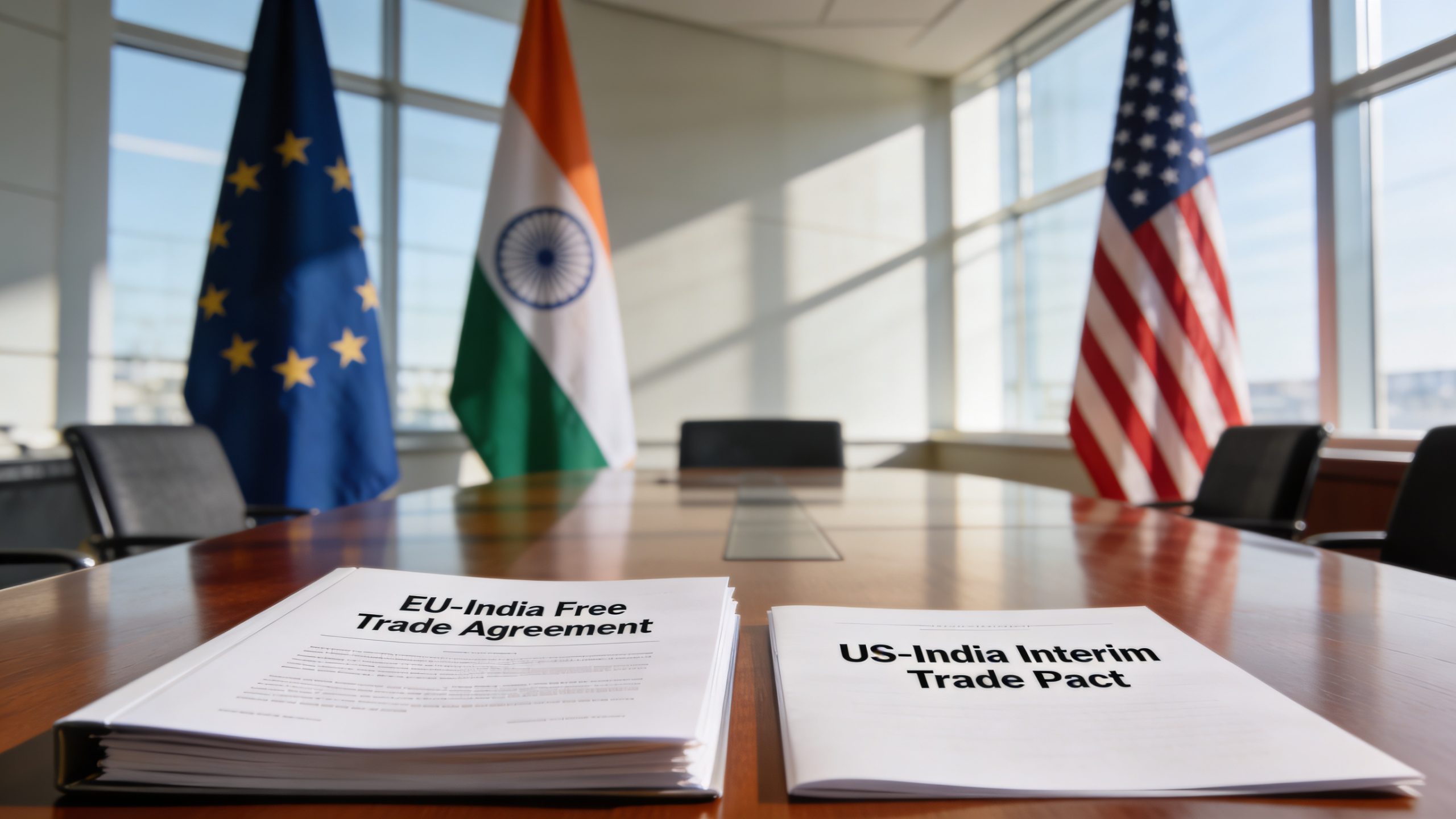
India is currently pursuing two distinct trade strategies by negotiating a comprehensive Free Trade Agreement (FTA) with the European Union (EU) and a limited interim trade framework with the United States (US). These approaches reflect India’s strategic efforts to balance deep economic integration with the EU while addressing specific, immediate trade priorities with the US.
The EU Free Trade Agreement (FTA)
Negotiations for a full Free Trade Agreement with the European Union signal a move toward deep economic integration. A comprehensive FTA typically covers a broad spectrum of economic activities, including trade in goods, services, investment, intellectual property rights, and sustainable development provisions. Such an agreement seeks to significantly reduce or eliminate trade barriers across multiple sectors.
A primary objective in the EU FTA negotiations is to achieve extensive tariff reductions. The goal includes working toward zero tariffs on a broad range of products, which could substantially lower costs for businesses engaged in India-EU trade. This approach aims to provide comprehensive market access and a level playing field for goods and services from both regions.
The US Interim Trade Deal
Parallel to the EU negotiations, India is working toward an interim trade framework with the United States. Unlike a full FTA, an interim or limited trade deal focuses on specific issues or sectors. These agreements are typically designed to address immediate trade irritants, provide targeted market access, or resolve specific tariff disputes.
An interim pact can offer quicker economic benefits by targeting a smaller, more manageable set of trade issues. It also serves as a foundational step for future cooperation, building trust and momentum for potentially broader trade discussions without the extensive scope and timeline required for a full FTA.
Comparing Tariff Approaches and Market Certainty
The difference in approach is evident in how tariffs are addressed. The EU FTA targets near-total elimination of tariffs across a broad spectrum of goods to integrate markets deeply. Conversely, an interim trade deal with the US is likely to focus on selective tariff adjustments for specific products, providing immediate relief rather than a sweeping overhaul of the tariff regime.
A full FTA with the EU provides a comprehensive and legally binding framework, offering businesses high certainty regarding market access and regulatory predictability. While an interim pact with the US offers faster results, its scope is more limited, providing certainty on specific trade aspects until a more comprehensive agreement is reached.
Strategic Intent
India’s pursuit of a full FTA with the EU reflects a strategic intent to diversify trade relationships and integrate with one of the world’s largest economic blocs for long-term growth. On the other hand, the interim deal with the US signifies a pragmatic approach to resolve specific disputes and gain immediate market access for key Indian exports, fostering greater economic cooperation within a broader bilateral relationship.